
- Home
- Company
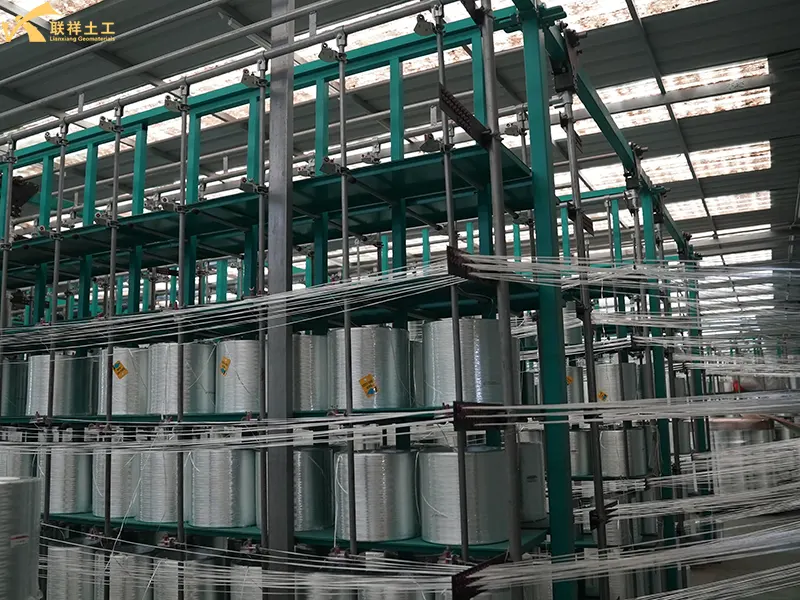
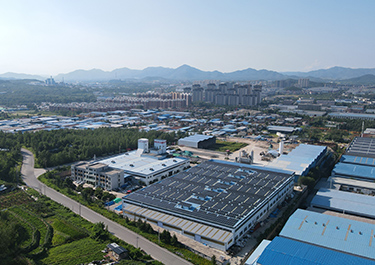 Our FactoryWe have a team of more than 30 talented geotechnical material R&D experts and a 30,000 square meter advanced modern intelligent manufacturing plant.
 - Products
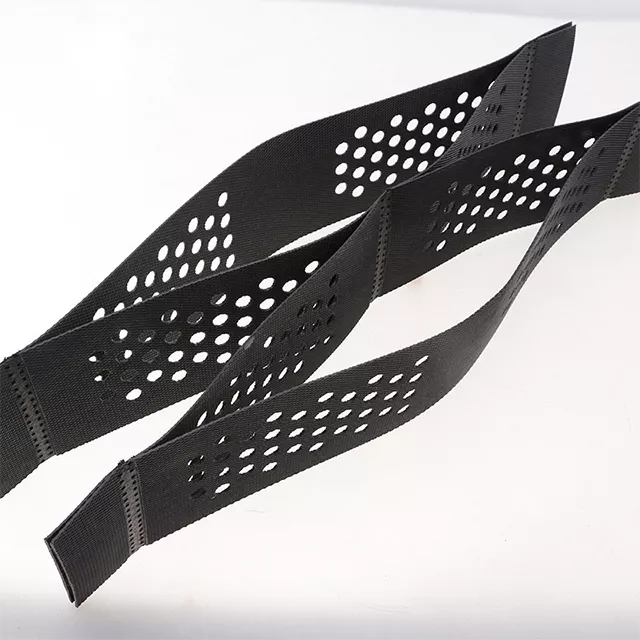 Geocell is a three-dimensional mesh structure made of high-strength polymer sheets (such as HDPE, PP, etc.) through ultrasonic welding. When unfolded, it presents a three-dimensional grid shape.
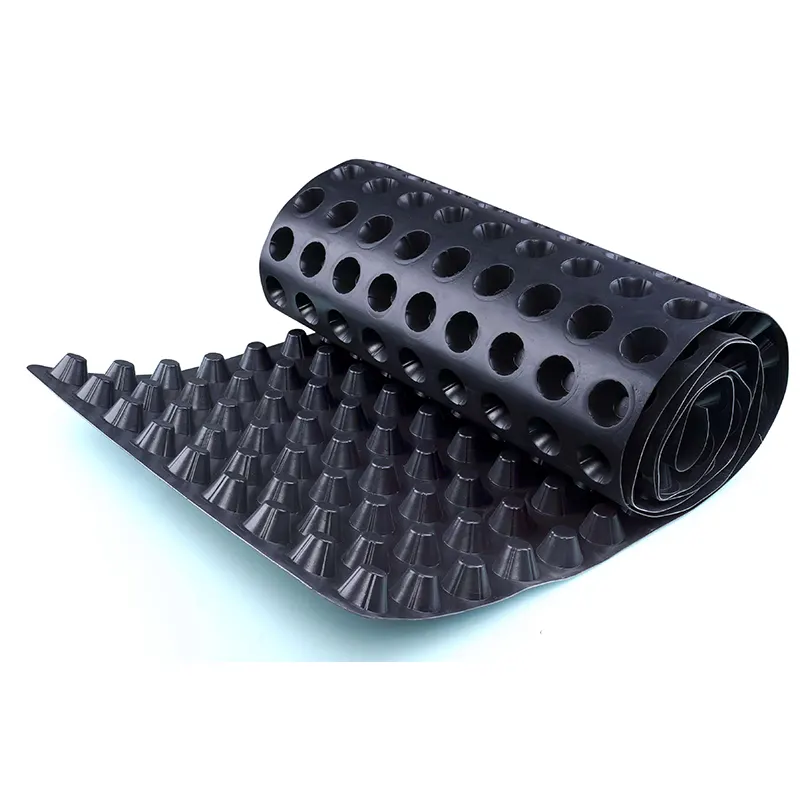
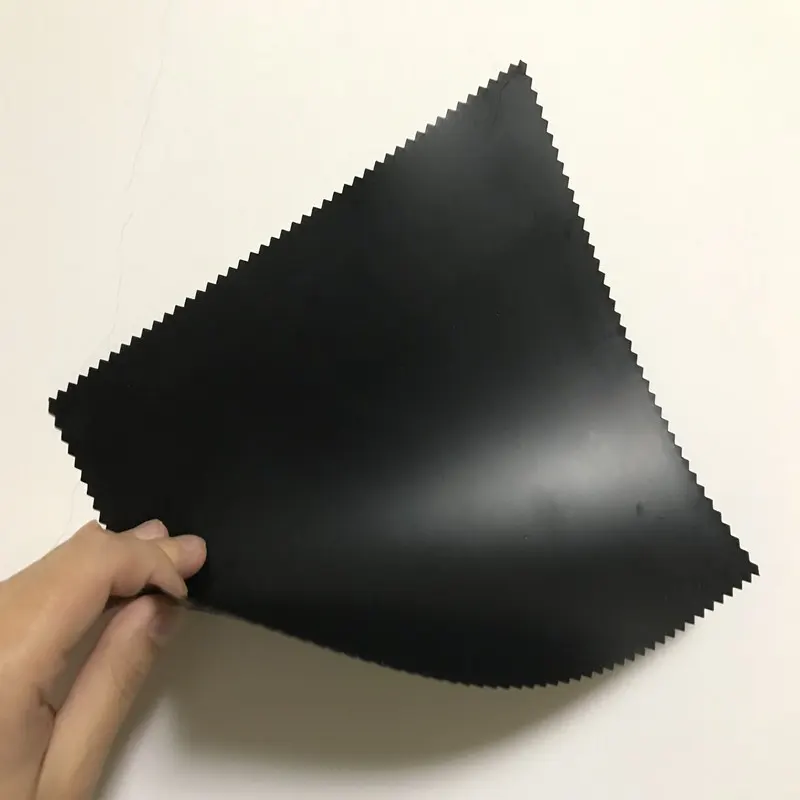 Geomembrane is a thin, extremely low-permeability sheet material made from high-molecular-weight polymers (high-density polyethylene, linear low-density polyethylene).
 - Blog
- Contacts
9 Key Empirical Demonstrations of Fiberglass Geogrids in Road Engineering


1. Tensile Strength
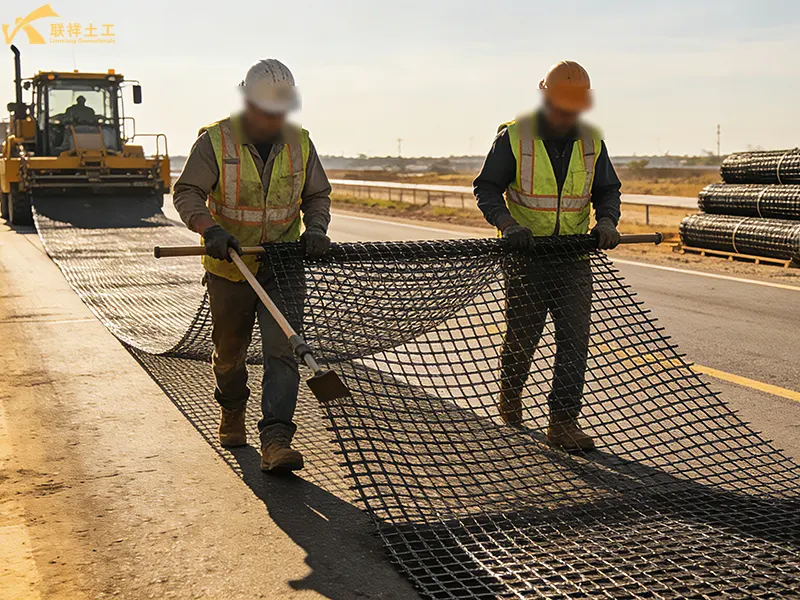
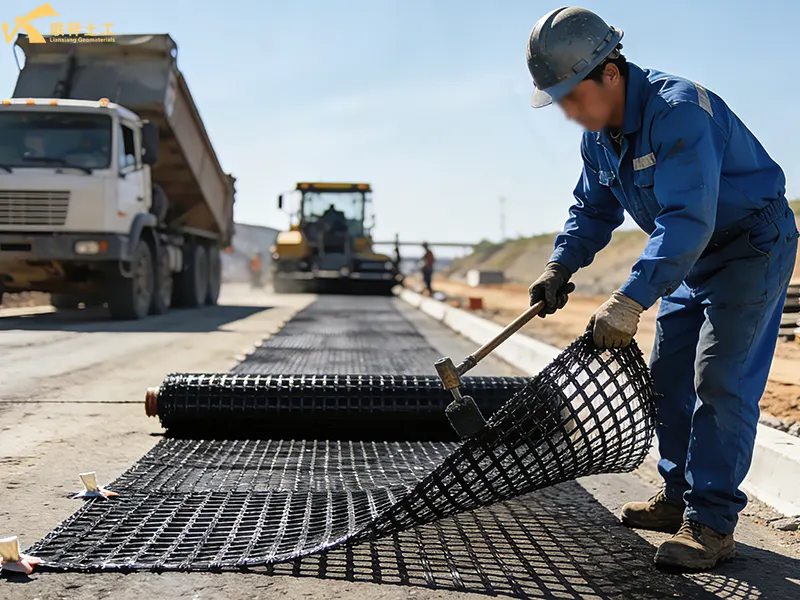
In road construction, the tensile strength requirement for fiberglass geogrids is not a fixed value but is comprehensively determined based on the application scenario (reinforcement, crack resistance, soft soil foundation treatment), design standards (highway grade, traffic load grade), and material specifications. Typically, the standard requirement is as high as 80-150 kN/m.
1.1. Core Indicator:
Lianxiang fiberglass geogrids are bidirectional geogrids. Specifications require that both their longitudinal (along the road direction) and transverse (perpendicular to the road direction) strengths must meet the design requirements simultaneously, and the difference between the two should not be too large.
Conventional Highways:
- Common specifications are 50 kN/m or 60 kN/m (i.e., longitudinal >=50 kN/m, transverse >=50 kN/m).
- This is the most common design requirement, used for overlaying existing roads and general roadbed slope protection.
Heavy Traffic, High-Grade Highways, and Special Sections:
- Common specifications are 80 kN/m, 100 kN/m, and even 120-150 kN/m.
- When used for "white-to-black" conversion of old cement pavements to resist reflective cracking, or for bridge approach slabs and soft soil treatment in high embankments, designers usually require a tensile strength of not less than 80 kN/m to ensure that it will not break under heavy impact.
1.2. Elongation at Break
Tensile strength must be paired with extremely low elongation at break to be of engineering significance. If the material elongates too much under stress, it cannot provide a "restraining" effect.
- Specification Requirements: The elongation at break of fiberglass geogrid must be <= 3%.
- Engineering Significance: This requires the geogrid to have an extremely high modulus of elasticity. Under asphalt pavement paving (160-180oC) and vehicle loads, the geogrid must remain rigid and not allow plastic deformation; otherwise, premature delamination or cracking of the asphalt layer will occur.
1.3. Joint Strength
Lianxiang fiberglass geogrid is woven and coated with warp and weft yarns; the fixing strength of the joints is crucial. If the joint strength is insufficient, even if the tensile strength of a single fiber meets the standard, the joint will slip or break under stress, leading to overall failure. Specification Requirements:
- According to standards, the shear strength or peel force of the joint should reach a specific value.
- Typically, the shear strength of the joint is required to be >= 10% - 20% of the nominal tensile strength.
- For example, for a 100 kN/m grid, the shear strength at the nodes is typically required to be no less than 10 kN/m or to withstand 200 fatigue loads without damage.
1.4. Specific Selection Requirements for Different Application Scenarios
Design drawings usually don't just state "tensile strength meets the standard," but rather define the indicators based on the function:
| Application Scenarios | Core Requirements for Tensile Strength | Remarks |
| Asphalt Pavement Overlay (Anti-Reflective Cracks) | >= 60 kN/m (usually EG6060) | Primarily utilizes high tensile strength to resist the tensile stress generated by the propagation of cracks in the old road. |
| New and Old Subgrade Splicing (Anti-Differential Settlement) | >= 80 kN/m | Used inside embankment fill. Due to the large lateral thrust generated by the soil's own weight and traffic loads, higher strength is required. |
| Soft Soil Foundation Treatment (High Fill) | >= 100 kN/m (even 150 kN/m) | In soft soil foundations, geogrids mainly bear the tensile stress caused by the enormous overburden pressure, requiring low long-term creep rupture strength (glass fiber has no creep advantage, but extremely high strength requirements are needed during the short-term construction phase). |
| Abutment Backfill (Bridge Approach Settlement Prevention) | >= 80 kN/m (Dense Interlayer Spacing) | Needs to withstand the enormous impact load when vehicles pass through the bridge abutment at high speed, requiring high dynamic stability against tensile strength. |
2. Reflective Crack Delay Effect:
In road construction, the requirement for delaying reflective cracks using Lianxiang fiberglass geogrid is a systematic technical indicator that permeates design specifications, material selection, construction techniques, and post-construction acceptance. It typically requires a delay time of 2-5 years.
2.1. Performance Indicator Requirements in the Design Stage
In the crack prevention design of asphalt overlays on old cement concrete pavements ("white-to-black") or semi-rigid base asphalt pavements, the delay effect is reflected through equivalent conversion of structural layers.
- Equivalent Conversion Requirement: In design calculations, the stress-absorbing layer with fiberglass geogrid (usually combined with tack coat) is considered to have a "crack-resistant functional layer." Specifications require it to reduce the stress intensity factor at cracks in the old road by 50%-70%.
- Fatigue Life Improvement Requirement: Design documents usually specify that after adding fiberglass geogrid, the fatigue cracking life (fatigue cycles) of the asphalt overlay should increase by more than 2 times. This is the most crucial quantitative design indicator for the delay effect.
2.2. Specific Requirements for Material Selection (Regarding Crack Resistance)
To achieve the effect of delaying reflective cracking, Lianxiang fiberglass geogrid has stricter requirements than ordinary reinforcement scenarios:
High tensile strength + extremely low elongation:
- Requirement: For crack resistance, the geogrid is typically required to have a tensile strength >= 80 kN/m (bidirectional) and an elongation at break <= 3%.
- Reason: Only a high-modulus, non-deformable "rigid skeleton" can effectively withstand the enormous tensile stress generated by thermal expansion and contraction or load vibration from cracks in the old road surface, preventing stress from being directly transferred to the newly laid asphalt surface.
High-temperature resistant coating requirements:
- Requirement: The coating on the surface of the fiberglass geogrid must be able to withstand the asphalt mixture paving temperature of 160oC - 180oC, and the tensile strength retention rate at this temperature must be >= 90%.
- Reason: If the coating melts or the fibers slip during paving, its crack-delaying effect will instantly fail.
2.3. Process Requirements for Paving Location and Coverage
The delaying effect of reflective cracking is highly dependent on the construction process. Standards have strict structural requirements:
Paving Location:
- Requirement: It must be laid directly above the crack in the existing pavement or at the joint of the existing pavement slab. For non-full paving (only joint sealing), it is required to cover 50cm to 100cm on both sides of the crack.
- Data Support: The delaying effect of full paving (covering the entire pavement) is more than 40% higher than that of partial joint sealing. Therefore, full paving is usually required on heavy traffic or high-grade highways.
Overlap Length:
- Requirement: Transverse overlap width >= 15cm, longitudinal overlap width >= 20cm.
- Significance: When the overlap is not up to standard (less than 10cm), the joint is very likely to become a new stress concentration point, causing reflective cracking to occur prematurely at this location, thus greatly reducing or even eliminating the crack resistance effect.
2.4. Immediate Effect Verification During Construction
During construction, on-site tests are conducted to verify whether the expected effects can be achieved,Interlayer Bond Strength (Shear Resistance) Requirements:
- Requirements: After laying the geogrid and applying the tack coat, core samples are taken on-site for testing. The interlayer shear strength between the asphalt overlay and the existing pavement must be >= 0.4 MPa - 0.6 MPa (specific requirements depend on the highway grade).
- Correlation: If interlayer bond fails (delamination), the geogrid cannot work in concert with the structural layer to bear the load, and reflective cracks will penetrate the asphalt layer in a very short time (usually 3-6 months).
2.5. Post-Construction Acceptance and Effect Evaluation Indicators
This is the most direct empirical requirement for the "delayed effect," usually reflected in project acceptance and maintenance commitments:
Crack Density Control:
- Requirement: Within 1-3 years after completion and acceptance, the incidence rate of reflective cracks (crack length/unit area) in road sections with fiberglass geogrid should be reduced by more than 70% compared to the un-laid control section.
Crack Occurrence Time:
- Requirement: In the overlay of old cement pavement, it is generally required that the occurrence of reflective cracks after geogrid installation should not be earlier than 1/3 of the design life.
- Example: If the design service life is 8 years, then no through-cracks caused by reflective cracks should occur within the first 3 years. The industry-recognized standard is that no structural reflective cracks should appear within 2-5 years.
Pavement Condition Index (PCI) Requirements:
- Requirement: During final acceptance and subsequent periodic inspections, the PCI decay rate of paved sections should be significantly lower than that of unpaved sections. Typically, a PCI value of >= 90 (excellent level) is required for at least two years.
2.6. Mandatory Requirements for Specific Scenarios
In certain specific road sections, specifications or owner requirements mandate specific delay effects:
- Bridge approach slabs: Due to large differential settlement, fiberglass geogrids must be able to 100% eliminate reflective cracks caused by the differential settlement between the approach slab and the subgrade (i.e., zero tolerance for cracks is required here).
- Heavy traffic sections: The geogrid must be able to withstand over 1 million cycles of standard axle load (BZZ-100) without fracture leading to reflective cracking.
3. Fatigue Life Improvement
Fatigue life refers to the number of load cycles an asphalt pavement withstands from commissioning to the appearance of structural fatigue cracks under repeated traffic loads. Lianxiang fiberglass geogrid can significantly extend the fatigue life of pavements, typically by 2.0 to 3.5 times.
3.1. Reducing Tensile Strain at the Bottom of the Asphalt Layer
Fatigue cracking in asphalt pavements usually begins in areas of concentrated tensile stress/strain at the bottom of the surface layer or the top of the base layer.
- Function: Fiberglass geogrid, laid at the bottom of the asphalt layer or the top of the base layer, bears most of the tensile stress due to its high modulus (elastic modulus of approximately 50 to 70 GPa, much higher than that of the asphalt mixture).
- Data: Finite element analysis and experimental results show that laying fiberglass geogrid can reduce the maximum tensile strain at the bottom of the asphalt layer by 30% to 50%. Strain is the direct driving force of fatigue damage; a reduction in strain means an exponential increase in fatigue life.
3.2. Delaying the Propagation and Penetration of Microcracks
Fatigue is a progressive damage process, from the initiation and propagation of microcracks to the eventual formation of penetrating cracks.
- Function: As a bridging material, fiberglass geogrids, when micro-cracks appear in the base or underlying asphalt layer, have their warp and weft fibers bridging both sides of the crack, transferring the stress at the crack tip to the surrounding material and preventing the crack from propagating upwards.
- Empirical Evidence: In crack propagation tests, the crack propagation rate of reinforced specimens was reduced by 50% to 70% compared to unreinforced specimens.
3.3. Improving Interlayer Constraint and Integrity
Asphalt layers undergo bending deformation under load, and interlayer shear slip exacerbates fatigue damage.
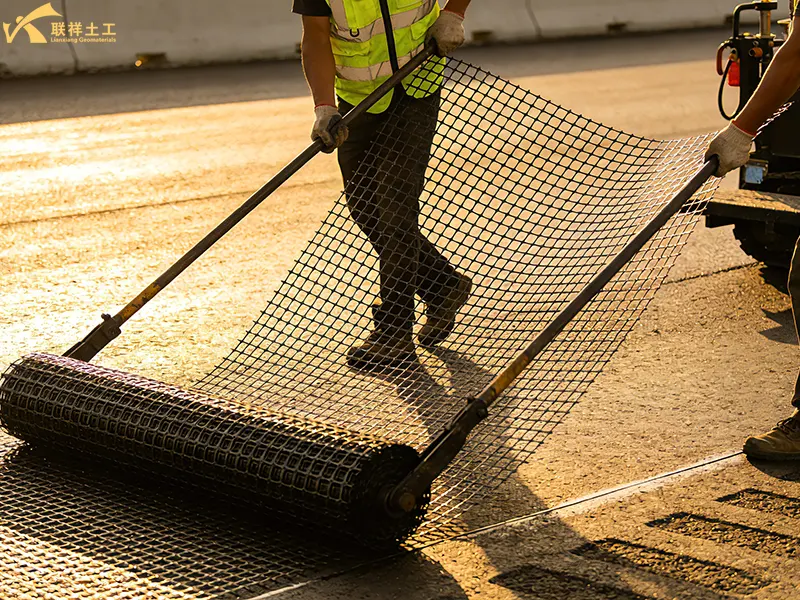
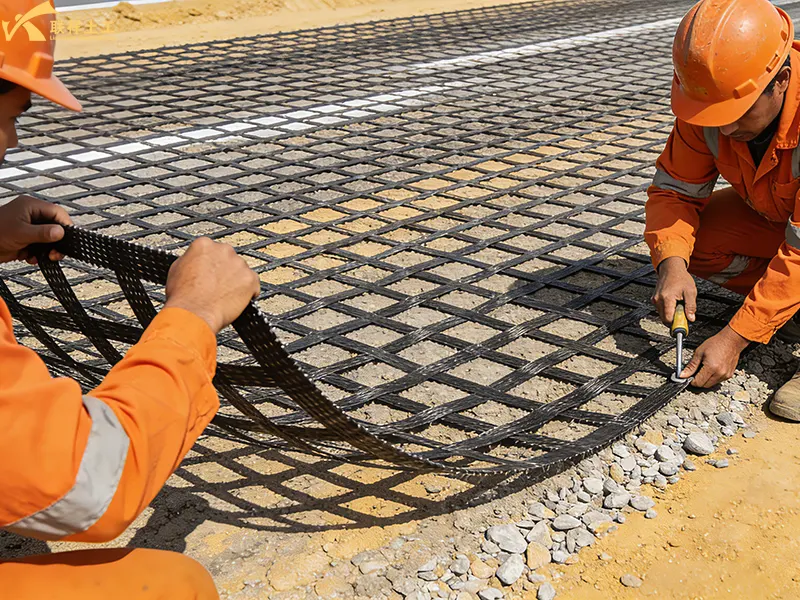
- Function: The fiberglass geogrid, together with the tack coat, forms a "stress absorption + constraint" system, enhancing interlayer bonding and preventing relative slippage between the asphalt layer and the underlying layer.
- Data: The interlayer shear strength can be increased from approximately 0.2 to 0.3 MPa without geogrids to 0.5 to 0.8 MPa, significantly improving the structural integrity and delaying the accumulation of fatigue damage.
4. Reduced Asphalt Layer Deflection
Deflection is an important indicator reflecting the overall strength and stiffness of the pavement structure. Using Lianxiang fiberglass geogrid can typically reduce it by 15% to 30%.
4.1. Increased Equivalent Modulus of Structural Layers
- Mechanism: The elastic modulus of fiberglass geogrid is as high as 50 to 70 GPa, which is 10 to 50 times that of asphalt mixtures (usually 1 to 5 GPa) and 3 to 5 times that of semi-rigid base courses (usually 10 to 20 GPa). Laying it at the bottom of the asphalt layer or on top of the base course is equivalent to embedding a high-modulus "reinforcing layer" within the structural layer.
- Effect: According to layered elasticity theory, under the same load, the overall stiffness (equivalent modulus) of the structural layer increases, leading to a reduction in vertical surface displacement (deflection).
4.2. Improved Load Diffusion and Stress Distribution
- Mechanism: When vehicle loads act on the pavement, they diffuse downwards through the surface layer and base course. Fiberglass geogrid, acting as a "tension membrane" or "reinforcing material," diffuses the vertical stress concentrated under the wheel track area to a wider surrounding area through its warp and weft fibers.
- Effect: Finite element analysis shows that after laying fiberglass geogrid, the maximum vertical compressive stress at the bottom of the asphalt layer (or the top surface of the base course) can be reduced by 10% to 20%, while the stress influence range expands by approximately 30%. The reduction in peak stress directly leads to a decrease in deflection.
4.3. Enhanced Interlayer Constraint and Shear Stiffness
- Mechanism: Deflection includes not only vertical compression but also relative slippage and bending deformation between layers. The composite interface formed by the fiberglass geogrid and tack coat significantly improves the shear stiffness between the asphalt layer and the underlying layer (base course or old pavement).
- Effect: The interlayer shear strength increases from 0.2 to 0.3 MPa without geogrid to 0.5 to 0.8 MPa. With reduced interlayer slippage, the overall structure is closer to a "completely continuous" state, and the deflection value decreases accordingly.
4.4. Suppressing Lateral Deformation
- Mechanism: Under load, the pavement structure undergoes not only vertical compression, but also lateral extrusion of the asphalt mixture on both sides of the wheel track (especially in hot seasons). This lateral flow exacerbates vertical deflection.
- Effect: The mesh structure of the fiberglass geogrid provides lateral constraint on the asphalt mixture, suppressing its lateral flow. Rutting tests show that lateral strain can be reduced by 20% to 40%, indirectly reducing the increment of vertical deflection.
4.5. Effects
The effect of fiberglass geogrid on reducing deflection varies in different scenarios.
| Application Scenarios | Deflection Reduction | Mechanism Emphasis |
| Overlaying Asphalt on Existing Cement Pavements | 20% - 30% | Primarily suppresses local stiffness reduction caused by reflective cracking; the geogrid acts as a stress-dispersing layer, reducing abrupt deflection changes at joints. |
| New Construction/Reconstruction/Expansion of Semi-Rigid Base Asphalt Pavements | 15% - 25% | Acts as a high-modulus reinforcing layer, improving the coordinated deformation of the base and surface layers, reducing overall deflection. |
| Soft Soil Subgrade Sections | 20% - 30% (Subgrade Top Surface Deflection) | The geogrid is laid on top of the subgrade or at the bottom of the subbase, constraining lateral deformation of the subgrade and increasing its resilient modulus. |
| Bridge Approach Slab Transition Sections | 25% - 35% (Differential Deflection) | Focuses on reducing the deflection difference between the approach slab and the subgrade, achieving gradual stiffness change and preventing bridge approach slab settlement. |
5. Asphalt Overlay Thickness Reduction:
Utilizing the high modulus and high strength characteristics of Lianxiang fiberglass geogrid, while maintaining or improving the pavement structure's load-bearing capacity (deflection, fatigue life), the thickness of the asphalt structural layer is reduced, directly decreasing the amount of asphalt mixture used. This typically results in a 20% to 30% reduction in thickness.
5.1. Asphalt Layer Thinning
Key Data: In the design of existing road overlays or new pavement structures, laying a layer of high-strength fiberglass geogrid (>=80 kN/m) can reduce the thickness of the asphalt overlay or surface layer by 2 to 6 cm, equivalent to a 15% to 30% saving in asphalt mixture usage.
| Application Scenarios | Thickness of Asphalt Layer Without Grille | Thickness of Asphalt Layer with Grille | Thinning Thickness | Percentage Reduction in Asphalt Usage |
| Overlay of Existing Cement Road ("White to Black") | 10 - 12 cm (Conventional Overlay) | 7 - 9 cm (with Grille) | 3 - 4 cm | 25% - 30% |
| New Construction of Semi-Rigid Base Asphalt Pavement | 18 - 20 cm (Top Layer + Bottom Layer) | 15 - 17 cm (Optimized) | 2 - 4 cm | 15% - 20% |
| Reconstruction and Expansion of Heavy Traffic Sections | 20 - 24 cm (Reinforced Structure) | 16 - 20 cm (with Grille Reinforcement) | 4 - 6 cm | 20% - 25% |
5.2. Equivalent Thickness Conversion Factor:
- In design calculations, the role of Lianxiang fiberglass geogrid is usually reflected through equivalent thickness conversion. Typically, one layer of geogrid is approximately equal to 2-4 cm of asphalt layer.
- For existing road overlay projects where crack resistance is the primary concern, the conversion factor is relatively large (3-4 cm) because the geogrid's contribution to suppressing reflective cracking is significantly better than simply increasing the asphalt layer thickness.
- For new construction projects where load-bearing capacity is the primary concern, the conversion factor is relatively small (2-3 cm) because the geogrid's contribution to overall deflection is relatively limited.
5.3. Asphalt Mixture Savings
Taking a two-way four-lane highway (approximately 22 m wide) as an example, the savings in asphalt mixture per kilometer are calculated to be approximately 200-600 tons per kilometer.
| Thinning Thickness | Asphalt Mixture Bulk Density | Asphalt Mixture Savings per Kilometer | Asphalt Savings per Kilometer (Asphalt-Aggregate Ratio 4.5%) |
| 2 cm | 2.4 t/m3 | Approx. 1,056 t | Approx. 48 t |
| 3 cm | 2.4 t/m3 | Approx. 1,584 t | Approx. 71 t |
| 4 cm | 2.4 t/m3 | Approx. 2,112 t | Approx. 95 t |
| 6 cm | 2.4 t/m3 | Approx. 3,168 t | Approx. 143 t |
Actual Engineering Scope: Considering design margins and construction factors, the average asphalt mixture saving per kilometer is 200-600 tons (asphalt saving 10-30 tons). The cost per ton (tons) is within the standard range; if it's an overlay on an existing road and the original design was thicker, the savings can reach over 1000 tons per kilometer.
5.4. Cost Comparison
While reducing asphalt usage lowers material costs, the use of fiberglass geogrid itself increases initial investment. Comprehensive Comparison:
| Project | No grating (Conventional Solution) | With grating (Thinning Solution) | Differences |
| Asphalt Layer Thickness | 10 cm | 7 cm | Reduced by 3 cm |
| Asphalt Mixture Cost | Approx. $22/m2 | Approx. $12/m2 | Saves $10/m2 |
| Fiberglass Grating Cost | $0/m2 | Approx. $3-$4/m2 (Materials + Construction) | Increases by $3-$4/m2 |
| Initial Total Cost | Approx. $22/m2 | Approx. $12-$18/m2 | Initial Savings $3-$4/m2 |
| Life Cycle Cost (15 Years) | Includes 2-3 Intermediate Repairs (Milling Overlay) | Includes 1-2 Intermediate Repairs | Overall Savings of 15% - 25% |

6. Reduced Rutting Depth:
While the primary function of fiberglass geogrid is crack resistance, its restraining effect also significantly inhibits high-temperature rutting, effectively reducing it by 20% - 40%.
- Empirical Data: In rutting tests, slabs with fiberglass geogrid significantly improved dynamic stability (DS), resulting in a 20% - 40% reduction in rutting depth compared to un-grounded sections. This is because the geogrid provides lateral restraint to the asphalt mixture, limiting the lateral flow of aggregates at high temperatures.
7. Improved Construction Efficiency: Paving Speed Increased by 50%
This data primarily reflects the improved coordination efficiency of construction machinery.
- Empirical Data: Compared to traditional geotextiles or stress-absorbing layers (such as rubber asphalt stress-absorbing layers), asphalt paving can proceed directly after fiberglass geogrid installation, without the need for curing or waiting. On-site construction data shows that in sections using fiberglass geogrids, the working speed of asphalt pavers can be increased from the conventional 2-3 m/min to 4-5 m/min, significantly reducing traffic closure time.
8. Temperature Stability: Stable performance within the -100oC - 280oC range
Road engineering faces extreme climate challenges, making the temperature resistance of materials crucial.
- Empirical data: Fiberglass is an inorganic non-metallic material, and its elastic modulus remains essentially unchanged within a temperature range of -100oC to 280oC. During the high-temperature paving of asphalt mixtures at 160oC - 180oC, fiberglass geogrids do not soften, shrink, or creep, a hard indicator that ordinary plastic geogrids (such as polypropylene) do not possess.
9. Long-term economic benefits: 15% - 25% reduction in life-cycle costs
The above data ultimately translates into economic benefits.
- Empirical Data: According to the "Life Cycle Cost Analysis (LCCA)" reports from the Highway Research Institute of the Ministry of Transport and several provinces, although the initial material cost of fiberglass geogrid is increased (accounting for approximately 2%-5% of the total cost), the overall maintenance cost can be reduced by 15% to 25% over the 10-15 year design service life due to the significantly reduced frequency of later maintenance (such as milling and overlay).
Conclusion
These nine pieces of empirical data all point to a core conclusion: Lianxiang fiberglass geogrid, with its high tensile strength, extremely low elongation, and high-temperature stability, plays the role of a "skeleton" and "isolation layer" in road structures, significantly delaying reflective cracking, improving fatigue life, and on this basis achieving the economic goals of thinning design and reducing life cycle cost.
Written by
SHANDONG LIANXIANG ENGINEERING MATERIALS CO., LTD.
Kyle Fan
WhatsApp:+86 139 5480 7766
Email:admin@lianxiangcn.com
-
WhatsApp
-
E-MailE-Mail:admin@lianxiangcn.com
-
WeChatWeChat:18554180188